



What is the Difference Between CAGR and XIRR?
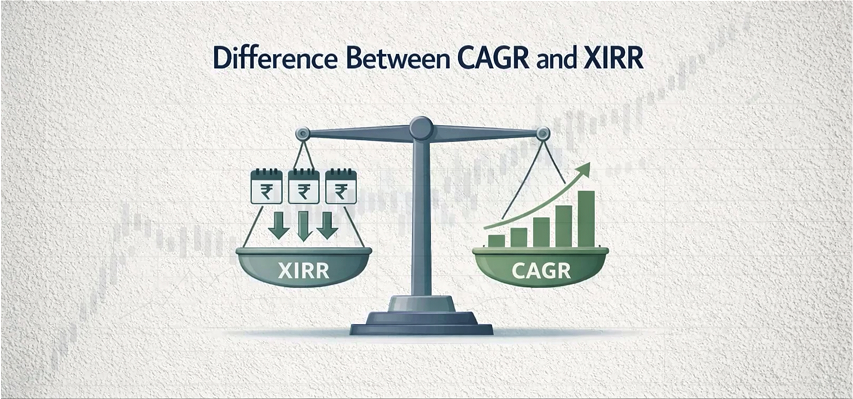
When investors assess the performance of their investments, they will notice two measures of return while evaluating mutual funds in India or other long-term investment schemes.
Choosing the right measure makes it easier to read performance numbers correctly and prevents conclusions that may not reflect how the investment actually behaved. This guide explains how these two return measures differ and when each one is more relevant.
When CAGR Works Better
CAGR is best suited for situations where a single amount is invested at the start and left untouched for a fixed number of years.
It works well for lump-sum mutual fund investments, stocks purchased at a single price, or tracking how an index has grown over time. In such cases, it gives a clear and straightforward picture of long term growth.
Since it assumes the entire amount was invested at the beginning, CAGR provides a simple view of overall performance. When the investment journey is straightforward, this measure offers an easy way to understand how steadily the investment has grown.
When XIRR is More Accurate
XIRR is more useful when investments are spread out over time. If money is added at different intervals, withdrawn partially, or invested through SIPs, this measure captures the impact of timing more accurately.
It reflects how your money actually worked across the investment period rather than assuming everything was invested at once. This makes it especially relevant for investors who invest in mutual funds through regular contributions.
In investing, where cash flows are rarely uniform, XIRR provides a more realistic picture of performance.
Difference Between CAGR and XIRR
| Basis of Comparison | CAGR | XIRR |
|---|---|---|
| Full form | Compound Annual Growth Rate | Extended Internal Rate of Return |
| Investment pattern | Assumes a single lump sum investment | Considers multiple investments and withdrawals |
| Timing of cash flows | Considers only start and end dates | Considers the exact dates of all transactions |
| Formula | Uses beginning value, ending value, and time period | Uses cash flows and their corresponding dates |
| Suitability | Best for one time investments held over a period | Best for SIPs and staggered investments |
| Ease of calculation | Simple and easy to calculate manually | More complex, usually calculated using Excel or tools |
| Accuracy for investing | Limited when cash flows vary | More accurate for practical investing scenarios |
| Common usage | Fund factsheets, index returns, long term stock analysis | SIP performance, portfolio-level return analysis |
Choosing the Right Metric
There is no universal return metric that fits every investment.
If your money were invested as a lump sum and left untouched, a simple growth rate would provide a clear picture. If investments were spread out over time, a time based return offers a more realistic view.
Many investors tracking mutual funds look at both measures together to better understand performance instead of relying on a single number.
Conclusion
These two return measures are not alternatives to each other. They serve different purposes and answer different questions. Understanding when to use each one helps investors avoid misreading returns and set more realistic expectations.
At Integrated, we help investors understand which return metric applies to their investments so they can evaluate performance clearly and make decisions with greater confidence.
Disclaimer - This blog is for educational and informational purposes only and does not constitute investment advice or a recommendation to buy or sell any securities or financial products. The comparison, examples and explanations provided are intended solely to help readers understand the conceptual differences between CAGR and XIRR and do not represent actual returns of any specific scheme, product or investment. Past performance is not indicative of future results. Investments in securities market are subject to market risks. Please read all related documents carefully and consult your financial advisor before making any investment decision.